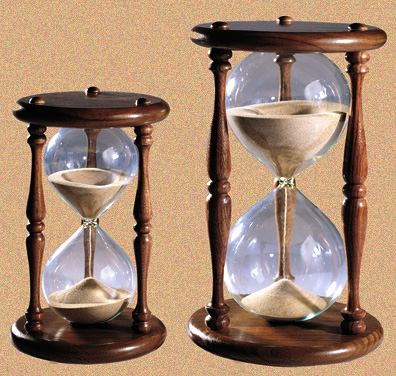
Nina must cook some pasta for 15 minutes. The only way she has of measuring time is a 7-minute sand-timer and an 11-minute sand-timer.
How can she use these timers to measure exactly 15 minutes?
I just came across a website called NRICH, a superb UK-based resource for maths teachers at all levels, a joint project between the Mathematics and Education Departments at the University of Cambridge. I’ll let them describe the aims of their project themselves:
NRICH aims to:
- Enrich the experience of the mathematics curriculum for all learners
- Offer challenging and engaging activities
- Develop mathematical thinking and problem-solving skills
- Show rich mathematics in meaningful contexts
- Work in partnership with teachers, schools and other educational settings
For teachers of mathematics, we:
- Offer you FREE enrichment material (Problems, Articles and Games) at all Key Stages that really can help to inspire and engage learners and embed RICH tasks into everyday practice.
- Help to promote RICH thinking in classrooms by offering on-line and face-to-face support at Primary and Secondary level.
- Deliver professional development courses and workshops in rich mathematics.
- Help teachers to think strategically about ‘next steps’ and progression in problem solving.
And for those learning mathematics, we:
- Provide FREE and interesting mathematical games, problems and articles.
- Encourage you to share your solutions to our mathematical problems.
- Have Mathematicians that can help you to solve problems - just ‘Ask NRICH’!
- Offer a safe online space where you can meet others with similar interests.
A note for parents:
- NRICH is a joint project between the Faculties of Mathematics and Education at The University of Cambridge
- Our FREE and extensive Rich Resource Bank has been designed to meet the needs of learners from ages 5 to 19 (Key Stages 1 to 5).
- Our resources are tested and proven and do make a difference.
- Rich tasks are suitable for learners of all ages and abilities.
I found several items in which sand cropped up (well, of course I would - as any reader of this blog is well-aware, the stuff is everywhere), but the puzzle caught my eye. It’s geared towards kids in the 5-10 age group, but I’ll readily admit that it took me a couple of minutes. And the interesting thing is that, if you go on the solution page, there are three different (but clearly related) methods of achieving what’s needed.
So, this post is titled “Sand Puzzles #1” - anyone want to contribute number 2?
[Sandglasses image borrowed, with appreciation, from La Crosse McCormick, “Manufacturers of Fine Timepieces”]
Comments
Michael,
This little puzzle is from “Mathematics for the Nonmathematician” by Morris Kline,Dover Books,1967; originally involved water(and US pints),but I modified it for gathering sand.
A man goes to a sand pile with two jars, one holding 3 liters and the other 5 liters. How can he bring back exactly 4 liters?
I can provide the answer on a follow up comment
Excellent - Sand Puzzle #2! I’ll leave it up for a while for readers to exercise their neurons over and then we’ll see how many solutions we get. I have one, but I’m sure there are several, and the challenge then becomes doing it in the smallest number of steps.
Michael,
I guess now it about past time to finish up the sand puzzle!:
The man fills the 5 liter jar and then fills the 3 liter jar from the 5 liter one. He empties the 3 liter jar and then pours the remaining 2 liters into the 3 liter jar. He now fills the 5 liter jar again with sand and pours enough to fill the 3 liter. Since there were 2 liters in the 3 liter jar and 1 liter is drawn down from the 5 liter jar, that leaves 4 liters in the it
There was another other way that I thought of by using the jars(if made of clear glass) as measuring cups by marking off the 5 liter level jar with the 3 liter level and 2 liters level on the 3 liter jar with “shifting sand” quantities betweeen them till I arrived at 4 liters.
Michael–
A little late off the mark, but here are my solutions to the two sand puzzles (I guess you can withhold this comment until you’re ready to reveal the answers):
Puzzle No. 1
Puzzle No. 2
P.S. Trivia: Puzzle No. 2 was used in one of the Bruce Willis “Die Hard” movies (the one in which Samuel L. Jackson co-starred).
Cheers,