April 2016
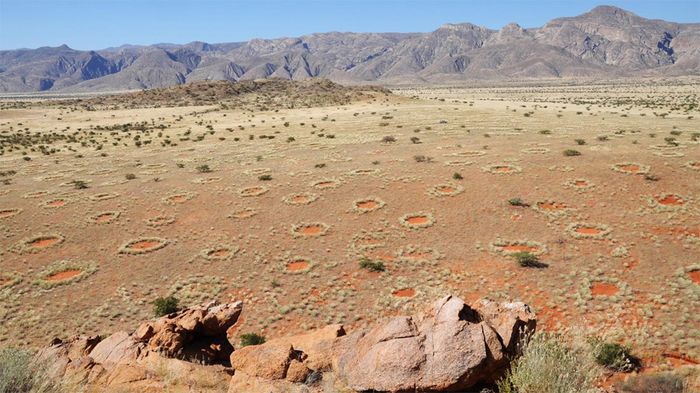
Described as one of the last great enigmas or mysteries, the so-called fairy
circles of the arid lands of Namibia remain to be explained. Theories abound,
and the fairies have stimulated “lively” academic debate, if not discord. The
circles occur in their millions in a band of dry grassland stretching 1800
kilometres south from the Angolan border - but it’s now clear that Australia has its own
fairies.
In both places, countless circles dot the landscape like a pox of some kind:
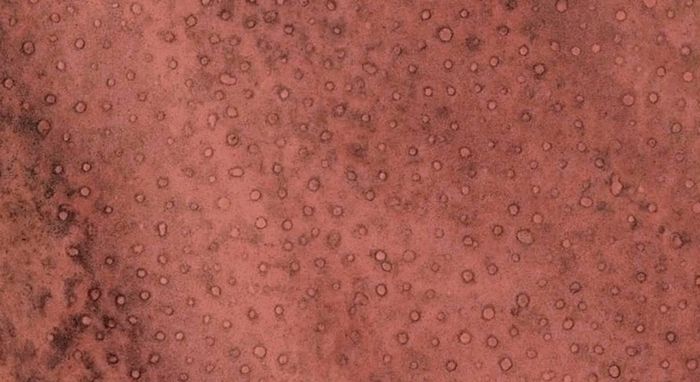
Fairy circles in the Marienfluss Valley of Namibia.
(Google Earth image, ~ 650m across)
The circles are rimmed with (more or less) growing grass, vary in size up to
several metres across and would seem to grow. Within them their is nothing
but bare earth. Explanations include ostriches, rolling zebras, underground
gas (or dragons’ breath), footsteps of the gods, microbial activity, poisonous
plants, termites, and the competition for scarce water. It’s the last two that
form the main rival hypotheses. As far as biologist Norbert Juergens of the
University of Hamburg is concerned, [it’s termites](http://www.livescience.com/28268-fairy-
circle-mystery-solved.html). But Stephan Getzin of the Helmholtz Centre for
Environmental Research (UFZ) in Leipzig disagrees - for him and his
colleagues, fairy circles result from the way plants organize themselves in
response to water shortage. Here’s the abstract of this group’s paper:
Vegetation gap patterns in arid grasslands, such as the “fairy circles” of
Namibia, are one of nature’s greatest mysteries and subject to a lively
debate on their origin. They are characterized by small-scale hexagonal
ordering of circular bare-soil gaps that persists uniformly in the landscape
scale to form a homogeneous distribution. Pattern-formation theory predicts
that such highly ordered gap patterns should be found also in other water-
limited systems across the globe, even if the mechanisms of their formation
are different. Here we report that so far unknown fairy circles with the
same spatial structure exist 10,000 km away from Namibia in the remote
outback of Australia. Combining fieldwork, remote sensing, spatial pattern
analysis, and process-based mathematical modeling, we demonstrate that these
patterns emerge by self-organization, with no correlation with termite
activity; the driving mechanism is a positive biomass–water feedback
associated with water runoff and biomass-dependent infiltration rates. The
remarkable match between the patterns of Australian and Namibian fairy
circles and model results indicate that both patterns emerge from a
nonuniform stationary instability, supporting a central universality
principle of pattern-formation theory. Applied to the context of dryland
vegetation, this principle predicts that different systems that go through
the same instability type will show similar vegetation patterns even if the
feedback mechanisms and resulting soil–water distributions are different, as
we indeed found by comparing the Australian and the Namibian fairy-circle
ecosystems. These results suggest that biomass–water feedbacks and resultant
vegetation gap patterns are likely more common in remote drylands than is
currently known.
Note “no correlation with termite activity.”
The patterns are fascinatingly regular and there has been a suggestion that
the geometry of organisation is, bizarrely, directly equivalent to that of
skin cells. Robert Sinclair, who heads the Mathematical Biology Unit at the
Okinawa Institute of Science and Technology Graduate University (OIST) in
Japan, and his collaborator, Haozhe Zhang, were the first to identify this
strange analogy.
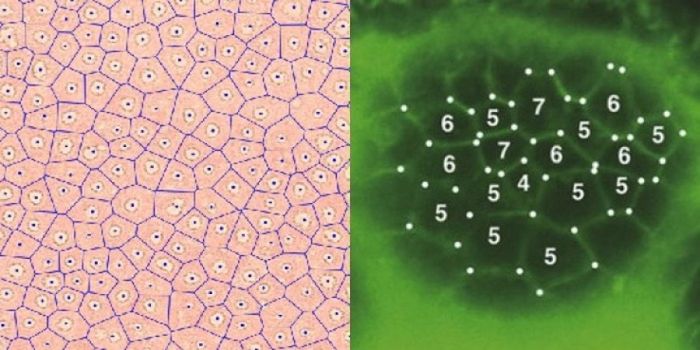
Two apparently unrelated systems on vastly different scales – fairy circles
in the Namibian desert (left) and microscopic skin cells (right) – appear to
share a similar pattern, which is very, very unusual.
Credit: Image courtesy of Okinawa Institute of Science and Technology - OIST
From the Science Daily report:
Both the majority of fairy circles and majority of cells have six neighbors.
But the similarity gets even more specific – the percentage of fairy
circles with four, five, six, seven, eight and nine neighbors is essentially
the same as the skin cells. “I didn’t expect it to be so close,” Sinclair
said. “We spent a lot of time checking because it really looked too close to
believe.”… The researchers suspect the patterns might be similar because both skin
cells and fairy circles are fighting for space. If true, scientists might
one day be able to glean information about systems just by analyzing
patterns. For example, they could search for signs of life on other planets
or moons, where images are usually the only data initially available.Finding such a pattern could also benefit ecology and biology in general.
Understanding processes on one scale could illuminate what is happening at
the other end of the spectrum. “Otherwise, we need a whole new theory for
each type of system we study, and may miss general principles, or, as some
say, not see the forest for the trees,” Sinclair said.
Self-organising systems and patterns are widespread and intriguing - I can’t
help but think of so-called “patterned ground,” the permafrost polygons of the
periglacial regions,
the patterns on Mars
(and now on Pluto), and various strange behaviours of granular materials…
Oh, and in aid of conservation in the NamibRand Nature Reserve, you can, if
you wish, [adopt a fairy circle](http://www.wolwedans.com/destination/fairy-
circles/).
[Image at the head of this post credit, Stephan Getzin. The [BBC has a very good
piece](http://www.bbc.co.uk/earth/story/20140916-mystery-
fairy-circles-defy-explanation) summarising this mysterious
phenomenon][](http://www.bbc.co.uk/earth/story/20140916-mystery-
fairy-circles-defy-explanation)
Originally published at: https://throughthesandglass.typepad.com/through_the_sandglass/2016/04/index.html
Discussion
No comments yet. Start the conversation!
Share your thoughts