July 2016
For one reason or another (likely to be discussed in a future post), I have
been working on an essay that attempts to address cross-cultural aspects of
viewing and valuing the land and reviews the potential implications for
learning geoscience through integrating “geomythology” (a less than perfect
term) into the process.
Coincidentally, in the course of seemingly endless research and reading, I
came a across a fascinating geoscience education story on sand. In 2014, the
American National Association of Geoscience Teachers
published two fascinating issues on the theme of “[Teaching Geoscience in the Context of Culture and
Place](http://nagt-
jge.org/toc/jgee/62/1),” full of provocative discussion and ideas. In the
[second issue](http://nagt-
jge.org/toc/jgee/62/2), one particular paper caught my attention: “Where Are
You From? Writing Toward Science Literacy by Connecting Culture, Person, and
Place,” written by Kanesa Duncan Seraphin from the Curriculum Research &
Development Group and the Center for Marine Science Education, University of
Hawai’i. As she writes in her abstract:
The ways in which people view the world, and by extension the ways in which
they learn, are shaped by cultural context. As educators striving to build
scientific literacy among our students, it is critical to bridge the gaps
among disparate cultures, traditional ways of knowing, and Western science.
Understanding the value of traditional knowledge and welcoming the discourse
and novel viewpoints associated with cultural and place-based practices is
the first step in opening the door of scientific literacy not only for
indigenous students but also for students struggling to find personal
relevance in science.
She discusses the disconnects in today’s world between science and culture
that can “distract students from effectively learning” and goes on to discuss
“Activities that connect sense of place and person provide opportunities for
students to learn about and integrate the human element of science with
scientific research and discovery.” Her focus is on personal writing that
helps students take ownership of their learning and facilitates students’
learning awareness. Writing provides a space for students to connect with
their culture and their thoughts—to think about what they know and believe,
thereby promoting metacognition and purposeful knowledge generation. Writing
also promotes scientific literacy by improving synthesis skills through the
construction of a written record.
Among the examples she discusses is a wonderful example of the results of
place-based learning by high school teachers taken first to the beach and then
to the lab to pursue experimental enquiry through personal connections. The
original exercises are described
here,
in what is, in itself, an excellent and valuable report well-worth reading).
However, it’s what Seraphin includes as feedback from the students that I
found particularly intriguing. In their writings, the students were encouraged
to record what they “used to believe” about sand and subsequently recognised
as misconceptions following the learning process. Here they are:
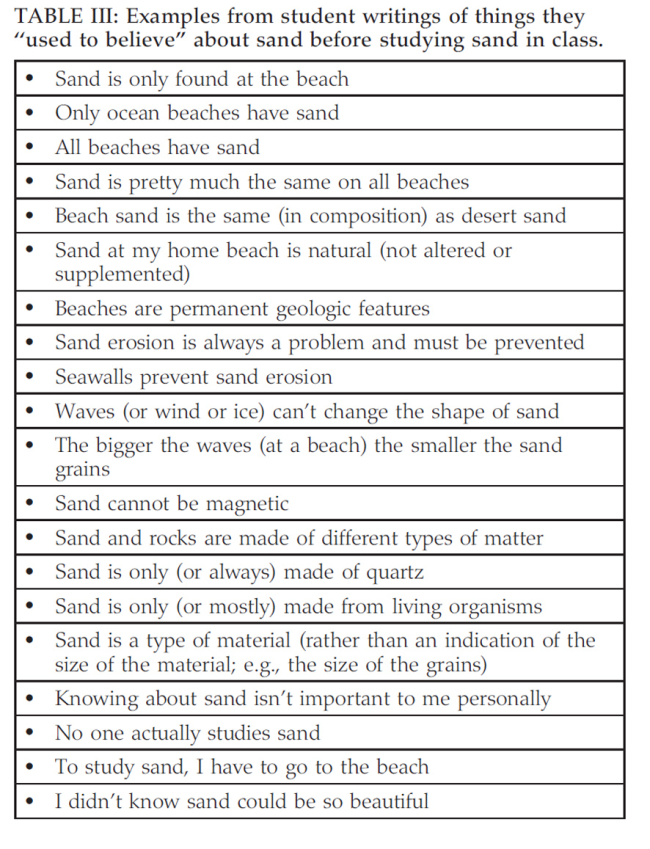
See why I found this so fascinating? As Seraphin comments:
This type of feedback is an important information-gathering step for
teachers and an important learning step for students. It also reflects the
ability of writing to engage students in the learning process by providing
the space and freedom for learners to express what they think (or used to
think) without fear of failure.
and in her conclusions
The working hypothesis is that enhancing place and personal connections in
science teaching will improve students’ self-efficacy and attachment to
science learning, thereby leading to increased retention in science courses,
higher test scores, better grades, and higher-quality student work. Writing
often and with cultural, and place-based, relevance is therefore recommended
as a thinking tool to personally and contextually connect the past, present,
and future aspects of teaching and learning.
“Hear, hear” is all I can say.
Originally published at: https://throughthesandglass.typepad.com/through_the_sandglass/2016/07/index.html
Discussion
No comments yet. Start the conversation!
Share your thoughts